Data Science and Data Engineering
End-to-end data services — from raw pipeline architecture to machine-learning-ready analytics — tailored for public administrations, research institutions, and EU-funded projects.
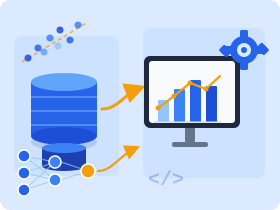
Services include:
- Data Pipeline Design and Engineering
Architecture and implementation of scalable ETL/ELT pipelines using modern tooling (Python, SQL, Apache Spark, dbt).
Integration across heterogeneous sources: databases, REST APIs, open data portals, and legacy systems. - Data Lake and Data Warehouse Architecture
Design of cloud-native or hybrid data platforms (Azure, AWS, on-premise) aligned with public-sector security and sovereignty requirements.
Schema design, partitioning strategies, and cost-optimised storage tiers for large datasets. - Exploratory Data Analysis and Statistical Modelling
Descriptive and inferential analysis to surface trends, anomalies, and actionable patterns in complex datasets.
Reproducible analytical workflows using Jupyter, pandas, and R for evidence-based policy support. - Machine Learning and Predictive Analytics
Selection, training, and validation of supervised and unsupervised models for classification, forecasting, and clustering tasks.
Deployment of explainable AI (XAI) pipelines that meet EU AI Act transparency requirements. - Data Visualisation and BI Dashboards
Interactive dashboards and reports (Power BI, Grafana, Plotly/Dash) for decision-makers and operational teams.
KPI frameworks and data storytelling to translate findings into governance decisions. - Data Governance and Quality
Definition of data dictionaries, lineage documentation, and quality rules for FAIR-compliant datasets.
Advisory on GDPR-aligned data handling and open-data publication workflows.
Deliverables
- Documented data-pipeline architecture and code repositories
- Data lake / data warehouse schemas and runbooks
- Analytical reports and reproducible notebooks
- Trained and validated ML models with performance benchmarks
- Interactive dashboards and KPI frameworks
- Data governance documentation and quality scorecards
Why Data Science and Engineering for the Public Sector?
Public institutions generate vast amounts of data — from administrative records and IoT sensors to satellite imagery and citizen surveys. Turning that raw data into reliable intelligence requires both rigorous engineering (so the data flows cleanly and consistently) and scientific rigour (so the models and statistics are trustworthy). With experience across EU research projects, national digital-transformation programmes, and open-data initiatives, I bridge the gap between data infrastructure and actionable insight.
Data Science e Data Engineering
Servizi dati end-to-end — dall’architettura delle pipeline grezze all’analisi pronta per il machine learning — progettati per pubbliche amministrazioni, enti di ricerca e progetti finanziati dall’UE.
I servizi includono:
- Progettazione e ingegneria delle pipeline di dati
Architettura e implementazione di pipeline ETL/ELT scalabili con strumenti moderni (Python, SQL, Apache Spark, dbt).
Integrazione tra sorgenti eterogenee: database, API REST, portali open data e sistemi legacy. - Architettura di Data Lake e Data Warehouse
Progettazione di piattaforme dati cloud-native o ibride (Azure, AWS, on-premise) allineate ai requisiti di sicurezza e sovranità del settore pubblico.
Schema design, strategie di partizionamento e livelli di storage ottimizzati per dataset di grandi dimensioni. - Analisi esplorativa dei dati e modellazione statistica
Analisi descrittive e inferenziali per identificare trend, anomalie e pattern nei dati complessi.
Flussi di lavoro analitici riproducibili con Jupyter, pandas e R a supporto delle politiche basate sull’evidenza. - Machine Learning e analisi predittiva
Selezione, addestramento e validazione di modelli supervisionati e non supervisionati per classificazione, previsione e clustering.
Deployment di pipeline di IA spiegabile (XAI) conformi ai requisiti di trasparenza dell’AI Act UE. - Visualizzazione dati e dashboard BI
Dashboard e report interattivi (Power BI, Grafana, Plotly/Dash) per decisori e team operativi.
Framework KPI e data storytelling per tradurre i risultati in decisioni di governance. - Governance e qualità dei dati
Definizione di dizionari dati, documentazione del lineage e regole di qualità per dataset conformi ai principi FAIR.
Consulenza su gestione dei dati allineata al GDPR e flussi di pubblicazione open data.
Risultati Deliverabili
- Architettura documentata delle pipeline dati e repository di codice
- Schema e runbook per data lake / data warehouse
- Report analitici e notebook riproducibili
- Modelli ML addestrati e validati con benchmark di performance
- Dashboard interattive e framework KPI
- Documentazione di governance e scorecard di qualità dei dati
Perché Data Science e Data Engineering per il settore pubblico?
Le istituzioni pubbliche generano enormi quantità di dati — da archivi amministrativi e sensori IoT a immagini satellitari e sondaggi sui cittadini. Trasformare questi dati grezzi in informazioni affidabili richiede sia un’ingegneria rigorosa (affinché i dati fluiscano in modo pulito e consistente) sia rigore scientifico (affinché modelli e statistiche siano attendibili). Con esperienza in progetti di ricerca europei, programmi nazionali di trasformazione digitale e iniziative open data, colmo il divario tra infrastruttura dati e insight operativi.